Portugal – USA
January 5, 2011
US politics are based on a master piece of constitutional law that resembles the master idea of Schuman and Spinelli, during the days when federalism was seriuously discussed in Europe on the basis of the Monet method of integration.
Portugal has a system of government that tried to recreate the french model of semi presidential(ism) from the mistakes and shortcomings of the I Republic, between 1910 and 1918, or 1923.
Portugal presents absolutely no political stability. The US model is a very predictable system of negotiations between the President and the opposition in Congress. Everybody, may they be involved and informed in politics or not, more or less know what to expect, in terms of results, based on a clear executive agenda. The presidential agenda may turn left or right on a certain issue, depending on the opposition realism of the facts. Obama may accept to review the health care bill, in exchange for something palpable for the american electorate to grasp: for instances, to accept the sustainability of taxation proportional over declared income.
In Portugal, in face of the facts of a recession, one sees a stronger reflex from the government to keep the status quo: The Prime Minister may overturn the Budget, the whole agenda based on a external, impalpable forseen threat, and confuse the electorate by threatening to unblock the negotiations on fast trains, driving the publics atention away from the real problems.
The US is a market based system: the financial markets, although under siege for lack of regulatory ties, they are able to easily predict and speculate on the trade and price trends, thus influencing the real political issues and setting the terms for political negotiations.
Portugal, during economic crisis, hides behind the intangible called obbligations towards European partners, fleeing the publics scrutiny, over the true complex nature of technical issues that evade most peoples understanding, leaving the citizens no other option but to accept disempowerement and isolation from the decision making process at home.
The solution to our problems in Portugal does not necessarily require a revolution. The reason why there is a mandated alternating party system is precisely to eat off any discontempt and throw sand on peoples eyes, so that the system perpetuates itself without structural change. Revolution did not mature the people in 74-82 to actually implement and execute a constitutional democracy in Portugal. A Glasnost and Prestroika also would not work, since it is a top-down method of policy enforcement, which has only one factor in common with our pathway to effective change: international pressure.
In Portugal pressure to change will come from a gradual replacement of our out dated development paradigms, such as our school teaching deeply inrooted model based on our past military achievements. Our priorities as to what defines us and makes our identity unique must surely change now. Our past historic successes ground us in our development as a people and perpetuate the old and paralysing political status quo.
Portugal may not rely on the Media to change mentalities and help build the future. Media is weak and spineless in Portugal. They merely report facts, on a small scale, and are not equiped to challenge the powerfull. Also, as a consequence, Media does not make politics and is not an agent of change. Media does not propose an alternative interpretation, does not promote models of analysis and does not reach out to the communities. So, its not a viable empowerement tool.
When Gutteres opened the precedent of resigning midway through his mandate, he was totally rejected by his own party, without exception, and no media ever resonated to its fullest such cowardly mass objection. This consensual and massive internal rejection showed how deeply immature our democracy in Portugal is. The party opposed the resigning Prime Minister and no corruption accusation had been or has ever since been raised against Guterres..However, guilty of breaking the Stability Pact or not, no Chief of Government ever had resigned in such a seemingly innocent way, since the beggining of constitutional democracy. The country, like today still completely isolated from policy making, ended up attacking the resigning head of government, siding by the party in power, giving them a new, clean, spotless confidence vote to restart and pick up where Guterres left from.
Guterres understood well the times ahead and launched an intelligent campaign pro-education, copying his European allies trend back then, like Blair and Schroeder, back to back with the last phase of German reunification and the Portuguese Presidency after Maastricht. This was the best idea we ve had so far, since Verney and other portuguese iluminists inspired the Marquis of Pombal in setting up the state controled education outside of the church.
In short, Portugal will change when expats from other parts of the world return with capital, new ventures, mindset, and start engrossing the class of a resident minority, up until recently represented in Portugal by personalities like Champalimaud, to change the “rational ignorance” of voters, the mentality of teaching politics from a Kissinger and European political elite points of view, and start introducing political analysis from a instiutionalist and masses or game theory points of view. At least start where others left, even if its been done and replaced.. Only then will irresponsible and corrupt governments stop from being nominated, elected and supported. Only then will these winds of change become mainstream and will voters and citizens become politically responsible and empowered.
Durao Barroso also saw this and, coherent with his youth leftist political influences, he idealized (and succeeded) to become a personality who, vested in a very particular role of being “anational”, but still very much a patriot and even extending his influence to other similar and possible future allies to Portugal, as is a EU Commission President traditionally expected to be, he steped aside from national politics, criticised by his own party, and country. The only difference between Barroso and the expat-role-model-country-saver, is that no one can tell how much he believes in a fast-track top-down solution for Portugal, much like Gorbachew in 1985.
The question is whether such a cultural revolution needs to take place by trial and error in several local communities simultaneously or whether it can happen in the two main cities in Portugal, considering Portugal cyclopic geographic vocation (Lisboa-Porto) ?
I dont necessarily think a Federal State is more prone to economic and political stability, but if we are to change our economic structures to promote political stability, no doubt would be better to attend the different regions in the country according to its owns specificities, to avoid a mono-culture type of specialization in software, like former bubble Ireland, and be able to diversify according to each regions competitive needs.
Portugal lies on the hopes and successes of the ever growing community of expats, immigrants and international capital.
2010 in review
January 2, 2011
The stats helper monkeys at WordPress.com mulled over how this blog did in 2010, and here’s a high level summary of its overall blog health:

The Blog-Health-o-Meter™ reads This blog is doing awesome!.
Crunchy numbers

A Boeing 747-400 passenger jet can hold 416 passengers. This blog was viewed about 4,200 times in 2010. That’s about 10 full 747s.
In 2010, there were 2 new posts, growing the total archive of this blog to 18 posts. There were 2 pictures uploaded, taking up a total of 219kb.
The busiest day of the year was February 2nd with 49 views. The most popular post that day was Egon Schiele 1890-1918.
Where did they come from?
The top referring sites in 2010 were blogcatalog.com, student-loan-consilidation.com, bigextracash.com, cordless-homephone.info, and studentloansinterest.org.
Some visitors came searching, mostly for dinesh d’souza, wine aroma wheel, aroma wheel, wine wheel, and religion fail.
Attractions in 2010
These are the posts and pages that got the most views in 2010.
Egon Schiele 1890-1918 November 2009
Relativity by M. C. Escher October 2009
1 comment
Berlusconi, il cavaliere October 2009
2010 Roundup
December 27, 2010
2010 wasnt a particularly good year but all things considered everything went well.
The national situation seems to be in between the conservatists rethoric and the liberals less poignant on their usual head marks.
Obama maybe handed a second term in 2012 easily as the republicans dont have an option but to support the democrats agenda in facing a soon to come massive debt dominating the political scene.
Unemployment will not be tackled through adopting more tight policies on immigration and certainly it wont be other than a marginal consequence of a bigger public concern over foreign policy and foreign trade.
For the remaining part of this mandate, the President will keep a low profile approach to big structural reforms, such as Health Care and Social Security, focusing now on the Middle East situation, with Turkey and Iran. With a global economy slowly escaping the US control, the State Department will be doing damage control and risk management with China on the Korean explosive situation, while very soon ascertaining the ratification of the new arms control treaty with Russia, with a dropping opposition from the conservative wing.
There is a new configuration of political forces in the US, but the radical right wing is only a reactive demonstration of populism and demaghogory that will open scene to a rather larger local and State regional policy making it a wider approach to national problems.
I expect the Democrats to retain a stable and even growing popularity amidst the general public for this year of 2011. Recent electoral upsurges in Ivory Coast, the instability in Sudan and the uprising of islamic marginalization from the epicenter of regional and international problems will certainly force the US to adopt other multilateral actions along with their Allies and the International Community, while probably and increasingly retreating from Iraq.
The Democrats seem to be dominating the backstage negotiations in Congress and the Senate while the Republicans may not have another chance but to hope for the Democrats to fall over from an excess of self confidence and wait patiently for an overturn. The results from the 2010 elections were prematurely overstated and overrated and they will be reevaluated soon in face of the Republicans expected impotence for an alternative.

Life Magazine Cover. actress Paulette Goddard in back raising a glass hoping to get the reporters attention crowding Gary Davis arrival to the US right out the ship SS America.
Carnegie Mellon Pittsburgh Graduate. Gary Davis was a former combatant of World War II, B 17 Bomber pilot. in 1948, from the streets of Paris he solemnly declared to renounce to his US citizenhip to become a “citizen of the world” .
In November 22 1948 he decided to burst in and interrupt a United Nations General Assembly session calling for a Government of the World. He became and is credited for being one of the inspirations for the adoption of The UN Declaration of HR in 1948.
From that step on forward he founded the “International Registry of the Citizens of the World”, in 1949 also in Paris, and over 750.000 individuals ran to register and become members.
In 1953 Davis declared the World Government for World Citizens from his pulpit in the City hall of Maine, his hometown. And from the legitimacy granted upon him by that statement in U.S. territory he finally created the World Service Authority, with the executi ve power of issueing Passports and birth certificates to applicants.
Davis used the World passport for the first time on a trip to india in 1956 and invariably he entered the country legally. Over 150 countries in the world have both at one time accepted and rejected the passport as a legal document to go through customs. Many times davis got deported and detained for questioning..
Among other visionary ideas, Davis defended the world currency to be a solar power based killowatt per hour mean of currency exchange on the 1992 Rio Conference for the Environment.
in 1971, the State of Minesota subscribed to the World Service Authority campaign of “Mundialization”, recognizing the citizens right to extend their sovereign rights over their own citizenhip beyond the limits of State government and Federal Government. By doing so they display the UN flag alongside the US flag outside the States Capitol, encouraging other States to follow their example. Minneapolis officials voted and adhered to the World Chart of Citizenship.
Many intelectual leaders wrote to subscribe to the young idealist campaign:
December 3, 1948:
Institute for Higher Studies
Princeton University, NJ
ALBERT EINSTEINI AM EAGER TO EXPRESS TO THE YOUNG WAR VETERAN DAVIS MY RECOGNITION OF THE SACRIFICE HE HAS MADE FOR THE WELL BEING OF HUMANITY. IN VOLUNTARILY GIVING UP HIS CITIZENSHIP-RIGHTS HE HAS MADE OF HIMSELF A “DISPLACED PERSON” IN ORDER TO FIGHT FOR THE NATURAL RIGHTS OF THOSE WHO ARE THE MUTE EVIDENCES OF THE LOW MORAL LEVEL OF OUR TIME…….
Highgate Village, London
Lord Yehudi MenuhinGarry Davis is symbolically defending the right of a human being to exist as an individual, even if he or she is in so unfortunate a position as to be an outcast, an exile, a refugee, without the protection of nations, tribe or family. He is determined. single-handed if necessary, to test the sincerity, the validity and the reality of the great human and social statements.
Ambassador of Goodwill to UNESCO
Here is the Program and form copy pasted from the official web site:
Dear World Citizen,
How to register as a World Citizen
You will have to print this form to register, since it requires a signature. To have a printed form mailed to you, write to the World Service Authority in Washington, D.C. (See address below)All registered world citizens will receive the World Citizen Card, laminated and in 7 languages: English, French, Spanish, Arabic, Russian, Chinese and Esperanto. The possession of this card is evidence of a global political status allied with each and every other declared and registered World Citizen.
CREDO OF A WORLD CITIZEN
A World Citizen is a human being who lives intellectually, morally and physically in the present. A World Citizen accepts the dynamic fact that the planetary human community is interdependent and whole, that humankind is essentially one. A World Citizen is a peaceful and peacemaking individual, both in daily life and contacts with others. As a global person, a World Citizen relates directly to humankind and to all fellow humans spontaneously, generously and openly. Mutual trust is basic to his/her lifestyle. Politically, a World Citizen accepts a sanctioning institution of representative government, expressing the general and individual sovereign will in order to establish and maintain a system of just and equitable world law with appropriate legislative, judiciary and enforcement bodies. A World Citizen brings about better understanding and protection of different cultures, ethnic groups and language communities by promoting the use of a neutral international language, such as Esperanto. A World Citizen makes this world a better place to live in harmoniously by studying and respecting the viewpoints of fellow citizens from anywhere in the world.
AFFIRMATION
I, the undersigned, do hereby, willingly and consciously, declare myself to be a Citizen of the World. As a World Citizen, I affirm my planetary civic commitment to WORLD GOVERNMENT, founded on three universal principles of One Absolute Value, One World, and One Humanity which constitute the basis of World Law. As a World Citizen I acknowledge the WORLD GOVERNMENT as having the right and duty to represent me in all that concerns the General Good of humankind and the Good of All. As a Citizen of World Government, I affirm my awareness of my inherent responsibilities and rights as a legitimate member of the total world community of all men, women, and children, and will endeavor to fulfill and practice these whenever and wherever the opportunity presents itself. As a Citizen of World Government, I recognize and reaffirm citizenship loyalties and responsibilities within the communal state, and/or national groupings consistent with the principles of unity above which constitute now my planetary civic commitment.X________________________________________________________
Signature of World Citizen and Date
Fill out below and sign Affirmation above and return with fee to:World Service Authority * Suite 205 * 1012 14th Street, NW * Washington, D.C. 20005 * Tel: (202) 638-2662 * Fax: (202) 638-0638
APPLICATION FOR A WORLD CITIZEN REGISTRATION
Please type or print all informationPlease include your US$30 world citizenship registration fee and choose the left or right column below according to your preference of making an annual financial commitment:
| FIRST NAME(S):______________________________________ FAMILY NAME:________________________________________ GENDER: M F BIRTHDATE: DAY_____ MONTH_____ YEAR___ BIRTHPLACE:_________________________________________ TELEPHONE:__________________________________________ FAX:________________________________________________ EMAIL:______________________________________________ OCCUPATION:_________________________________________ CURRENT MAILING ADDRESS: _________________________________________ _________________________________________ _________________________________________ |
| Registration fee: US$30 Annual minimum contribution to World Government (Optional): US$30 Required Postage: US$5 TOTAL: US$65 |
Registration fee: US$30 Annual minimum contribution to World Government (Optional): US$30 -or- US$___ Required Postage: US$5 TOTAL: US$___ |
Pittsburgh, great small city
July 31, 2010

Just moved in to Pittsburgh, living in the North Oakland area. After 4 years of Baltimore, this is a breath of fresh air..seriously!! Pittsburgh has a great feeling to it, Baltimore had the opposite! I suppose Pittsburgh reminds me a bit like an european city..
Its like the landscape, green hills surround the “buroughs”, blocking the eyesight beyond the city walls, but the numerous bridges over the rivers Mononghaella (is one, love the name..) prevent from any sense of claustrophobia or remembrance of how far away is the next beach..
Thearchitecture is beautifull! I love the combination of the (yet to be properly investigated on any future tour by me) seemingly victorian and the modern styles. The extensive gardens also add up to the university like, city-campus type (at least three world wide uniersities that I heard of are here: Pittsburgh, Carnegie Mellon and Duquesne).
I havent been yet to Squirrell Hill, one of the hipp sides of town, but from driving around i can tell the people are quite friendly and a lot more sophisticated then the “morons from Balto”..
I like the fact that Im moving deeper into the northwest, it gives me a sense of perspective into the future. Besides If anything, there are more options, in terms of cultural events and even shopping.
Shopping downtown is the way its suppose to be. In Baltimore shopping was done in the big outlets, usually in the outskirts. Park, spend and go..hate it! I like to get a pulse of the city, walk on the streets (preferably in safety), Baltimore streets are the harbour, and little more i think. And they re not really walkable..I tried walking up and down Pratt several times and its ugly, hard and unpleasant.
So far Im giving Pittsburgh high marks and I dont feel like its ever going to be down from here onwards..
Primal Hunt in Africa
November 8, 2009
these clips serve to show how our long forgotten need for survival makes us all so inhumane
Vodpod videos no longer available.
Egon Schiele 1890-1918
November 7, 2009
At the age of 15, he studied at Kunstgewerbeschule (the School of Arts and Crafts) in Vienna, where Gustav Klimt once hade been himself a student.
Invited by Klimt himself, Schiele had exhibit some of his work at the 1909 Vienna Kunstschau, where he encountered the work of Edvard Munch, Jan Toorop, and Vincent van Gogh. He was particulaly interested in the explicit forms of human nature.
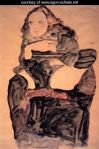
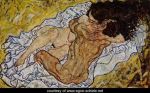
Schieler later escaped Vienna, accompanied by a former nude model called Wally, allegedly mistress of Klimt, to find comfort in Krumau (Cesky Krumlov)
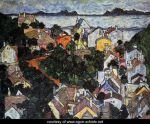
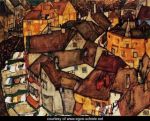
Cesky Krumlov
Cesky Krumlov is a beautiful Unesco world heritage city, in South Bohemia, the Czech Republic.
Nowadays Cesky Krumlov holds home to a museum in honor of the artist. However, Schiele and his mistress were banned by residents from the city, who dissaproved his lifestyle as a teen model recruiter.
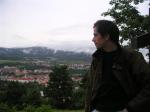 Cesky 2005
Again a fugtive, Schiele opens a studio in Neulengbach, 35 km west of Vienna, that becomes a refuge for orphan children in the city. Again the painter’s irreverent life style arouse the populations hate and Schiele was arrested at his home, under the charges of pedophaelia (for seducing a young girl bellow the age of consent).
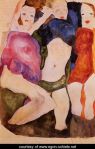
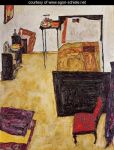
the police seized more than a hundred drawings which they considered pornographic. Schiele was imprisoned while awaiting his trial. The charges were droped but accusations of posession of explicit material still held up. The judge in court even burnt one of Shiele’s drawings over a candle light.
In 1915 Schiele got married to her neighbor across the street from his studio in the Viennese suburb of Hietzing, 101 Hietzinger Hauptstrasse. He still expected to maintain an off marriage relationship with his sister in law. In 1915, Schiele wrote a note to his friend Arthur Roessler stating: “I intend to get married, advantageously, perhaps not to Wally.”
Schiele was drafted to war, stationed in Prague, but his artistic talent earned him the respect of his superiors and allowed him to stay away from the front of battle, enabling him to continue painting while guarding russian prisoners.
He was invited to be part in the Secession’s 49th exhibition, held in Vienna in 1918. Schiele saw fifty of his works being accepted for this exhibition, and they were displayed in the main hall. He also designed the front poster for the exhibition, which was reminiscent of the Last Supper, with a portrait of himself in the place of Christ. The show was a tremendous success, and as a result, prices for Schiele’s drawings increased and he received many portrait commissions.

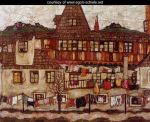
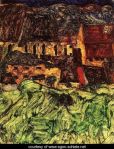
in 1918, his wife perished to the spanish flu epidemic that chyphered around 20 thousand lifes in Europe. She was 6 month pregnant.
Schiele died only three days after his wife and son, at the age of 28.

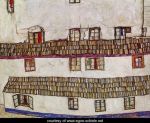
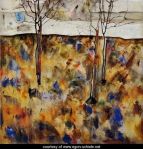
Monetary Policy and Free Trade Part II
October 26, 2009
The 1973 Oil Crisis was a consequence of a series of events that illustrate the downfall of free trade whenever the governments take on expansionary monetary policies to tackle a deficit on the balance of payments, without having a strong monetary reserve to adjust parity purchase power between currencies.
_/ /_
In the light of the Smithsonian Agreements, the European Economic Community (EEC) decides to self regulate, based on the Werner report of 1970.
Nicknamed by economists as the snake in the tunnel model, basically this meant pegging all EEC currencies to one other, through the coordination of macro-economic policies of the Member States. This trading model proposed a much larger bandwith than Bretton Woods, thus allowing currencies to go up or down 4.5% to the dollar. This allowed that one currency could go up 9% relative to the other.
It was then seen as necessary to improve on the permissive nature of the snake in the tunnel. The Basle Agreements of 1972 take place on the background negotiations for the Rome Treaty with its 6 Member States.
The new model of the snake in the tunnel limited the bilateral margins between European currencies to 2.5% with a maximum turn over of 4.5% and with all moving together against the dollar. This model killed the sterling pound monetary area, but eventually also collapsed when the U.S. dollar started floating freely. in 1977 the Deutsche Mark led as the reserve currency but only with Benelux and Danemark on its tail.
__/ /_
The 1973 Oil Crisis had strong effects on the Monetary Policy.
The OAPEC proclaimed an oil embargo to sanction the U.S. support to the Israeli on the Yom Kippur war. Europe and Japan disassociated themselves from the U.S. and Kissinger had to negotiate an Israeli retreat from the Golan Heights and the Sinai Peninsula right after the end of hostilities.
Right after Bretton Woods fall, started the free floating of the U.S. dollar, and most industrialized nations increased their reserves by printing more money , which resulted in a depreciation of the dollar and because oil price was indexed in dollars, oil producers were getting less value for the petro dollars, which made them issue the statement of pegging the oil barrel prices to the gold. OPEC/OAPEC were not ready to make the institutional adjustments from the volatility of the dollar after 1967.
With the Middle East hostilities, the West was increasing their energy bill by 5% per year and selling inflation priced goods back to the oil-producers countries in the Third-World. That led to the declaration of the Shah of Iran in 1973: “You increased the price of wheat you sell us by 300%, and the same for sugar and cement…; You buy our crude oil and sell it back to us, refined as petrochemicals, at a hundred times the price you’ve paid to us…; It’s only fair that, from now on, you should pay more for oil. Let’s say ten times more.”
With the demise of Bretton Woods, the world financial system fell into a recession of inflationary prices until the 1980s, while the oil prices continued to rise up until 1986.
The 73 oil crisis marked for that same reason the very beginning of alternative energy sources research, so popular in our days.
The Oil Producers immediately started accumulating a vast wealth and pipe lined some of those monies in the form of aid to other under developed or developing countries. The International Monetary Fund also created the “Oil Facility” instrument (1974-76) destined to help most affected nations to tackle their balance of payments deficit. The IMF loans were subject to one of two pre-conditions: a petro-dollar international payment deficit or a general balance of payments deficit.
in 1975 the European Economic Community also joint efforts and approved a regulation (law) on European Community loans.
The International community first instinct was to provide support first to the industrialized countries, those who supported Liberal Capitalism in the form of free trade and financial cooperation. The other support was made available, in the form of a special line of credit, to the Developing countries, whose economies had been caught between higher prices of oil and lower prices for their own export commodities and raw materials amid shrinking Western demand for their goods.
Those Non Alignment countries more often than not, with the exception of a few remarkable cases, ended up appropriating that structural adjustment financial loans and deviating it to their ideological programs, such as rearmament and cosmetic public spending infrastructures.
That meant that the credit institutions loans, like the IMF, The Paris Club of Creditors, the London Club of Creditors, were never repaid in full, while in debt nations spiraled into consecutive loans, that were granted simply to pay for accumulated interests in the short run, in the long run they could never fully regain international confidence, simultaneously degrading their future access to credit line. A few of the final consequences over this matter were moratoriums over the payments, regime nationalizations of oil wells and even civil wars. On the other side, International Creditors even went as far as forgiving outstanding multi-billion dollars debts just to prevent another collapse of the status quo, but unwillingly legitimizing corrupted regimes in the process and preventing reform.
_/ /_
in 1979 is born the European Monetary System, in the veils of the II oil shock crisis. Back then, the dollar was floating freely and the Deutsche Mark had limited adhesion from other European currencies. The European Monetary System created a central reserve currency, called the ECU (European Currency Unit). With the ECU it was also created an European Exchange Rate Mechanism (ERM), an extension of European credit facilities and the European Monetary Cooperation Fund (precursor of the European Central Bank: that allocated ECUs to Member States in exchange for Gold and U.S. dollar deposits).
The European Exchange Rate Mechanism created a `Parity Grid` of bilateral exchange rates based on the fixed currency exchange rate margins of the ECU (a semi pegged system where fluctuations were contained within a margin of 2.25% on either side of the bilateral rates, 6% to Italy and enlarging to 15% in 1993 to sustain speculation against the french franc). The ECU fixed exchange rate was based on a weighted average of the participating currencies.
There were two ECU’s: The Official ECU (mostly an accounting unit for reference, circulating among banking institutions), and the `private` ECU (used in international financial transactions). The ECU was regulated by the European Monetary Cooperation Fund (Brussels Resolution of 1978), that would manage the `snake in the tunnel` trends, issuing currency against the deposit of 20% of gold/dollar reserves of the Central Banks of the Member States, with a trimester review of the divergence indicator.
In the 1980’s most economists began to stand for a nation’s central bank independence from the executive to ensure a smoother monetary policy (avoid its manipulation over party politics and electoral fault moves).
The debate over the European Economic Monetary Union, was again launched by the Delors Committee in 1988 (The Member States Central Banks Governors met around the President of the European Commission). And in 1989 the Delors Report set up a 3 stage plan to roll out the EMU, including the creation of The ESCB (European System of Central Banks):
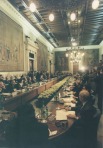
-Stage 1 (1990-93)- exchange controls were abolished, thus capital movements were completely liberalised in the European Economic Community
-Stage 2 (1994-98)- The European Monetary Institute replaces European Monetary Cooperation Fund and is later baptised European Central Bank, setting up the conversion rate for the 11 participating currencies to the EURO; The Stability Pact gets approved at the European Council of Amsterdam to ensure budgetary discipline after rolling out of the euro, and a new exchange rate mechanism (ERM II) is set up to provide stability above the euro and the national currencies of countries that haven’t yet entered the eurozone.
-Stage 3- (1999)- single monetary policy is introduced under the authority of the ECB. A three-year transition period begins before the introduction of actual EURO cash.
_/ /_
In the 1990s, central banks started to adopt formal, public inflation targets with the goal of making the outcomes, if not even the process, of monetary policy more transparent. This is to say if a targeted inflation is not achieved then the central bank will typically have to submit an explanation.
The Bank of England exemplifies both these trends. It became independent of government through the Bank of England Act 1998 and adopted an inflation target of 2.5% Retail Prices Index (now 2% of Consumer Prices Index).
The underlying point is about whether monetary policy can soften up business cycles or not. Keynes principle is that the central bank can stimulate aggregate demand in the short run, because a significant number of prices in the economy are fixed in the short run and firms will produce as many goods and services as are demanded.
Nowadays most economies in the world have an inflation targeting (Conumer Price Index) type of monetary policy. These include the U.S. ( a mix model), the European Union and the single currency (EURO), Australia, Brazil, Canada and India, UK. The great exception is China.
The inflation target is achieved through periodic adjustments to the Central Bank interest rate target. The interest rate used is generally the interbank rate (ex: EURIBOR) at which banks lend to each other overnight for cash flow purposes.
To achieve inflation targets, Central Banks resort to open market operations (sales and purchases of second hand government debt or changing reserve requirements: If the central bank desires to lower interest rates, it purchases government debt, therefore increasing the amount of cash in circulation; A central bank can only operate a truly independent monetary policy when the exchange rate is floating. If the exchange rate is pegged or managed in any way, the central bank will have to purchase or sell foreign exchange).
Changes to the interest rate target are made in reaction to many market indicators in an tentative to forecast economic trends and thus keeping the market on track towards achieving the defined inflation target.
_/ /_
in 1998 the ECU exchange rates of the Eurozone countries were frozen and the value of the EURO, which then superseded the ECU at site, was therefore established. In 1999 the ERM II replaced the first ERM. A currency in ERM II is allowed to float within a range of plus or minus 15% with respect to a central rate against the euro.
The characteristics of an Economic Monetary Union are free circulation of capitals in a free market area , where member states join in common commercial policy (competition), adopting a series of convergence criteria in the macro economic sphere (budget, fiscal, monetary). Within the monetary union, there is an assurance of absolute convertibility of the currencies between each other in a fully integrated banking and financial unitarian system. Elimination of fluctuation margins and an irrevocable determination of parities.
Monetary Policy and Free Trade- Part I
October 22, 2009
After the II World War, monetary policy was quickly addressed by the world leaders who proposed to reaffirm it against the governments regulatory control. They argued that it was not to be used anymore by national governments to artificialy regulate trade deficit.
This international initiative sustained that the market economies should uphold their inherent competitive nature (supply and demand), by discouraging countries to depreciate their currency in order to obtain commercial bilateral and temporary advantages.
According to the theories of uncovered interest parity (Fisher Hypothesis) and parity purchasing power (Cassel 1918): two currencies have different purchasing power, which differential may be overcome by inflation rates. An example of one measure of PPP is the Big Mac Index made popular by the Economist magazine which looks at the prices of a Big Mac burger in McDonald’s restaurants in different countries.
This pictoresque illustration serves to show that a dollar should buy the same amount in all countries. Thus in the long run, the exchange rate between two countries should move towards the rate that equalises the prices of an identical basket of goods and services in each country.
The Big Mac PPP is the exchange rate that would mean hamburgers cost the same in America as abroad. Comparing actual exchange rates with PPPs indicates whether a currency is under- or overvalued (The Economist.com).
In other words, both imports and exports would balance one another and exempt governments from imposing strong expansionary monetary measures. There would be market regulation over policy increases in the size of the money supply, or decreases the interest rate, such as expanding currency production and restraining foreign currency exchange.
Global monetary affairs came about after the shock effect of the Great Depression in 1929, when international trade was largely restricted to currency blocs, like the sterling area and the British empire. the US State Secretary Cordell Hull (1933-1944) was a strong believer in a `Economic Security` concept based on the premise that the fundamental cause of the wars lay in economic discrimination and trade warfare.
The regulatory effect would be introduced to prevent wild fluctuations in exchange rates and sudden currency depreciation, those could disastrously stall international trade from flowing freely (like was happening in the 1930s).
The key note was convertibility of currencies. In Bretton Woods is born the system of `adjustable parities` for international payments, returning to the gold standard as it was before the war, only this time using $U.S. as the world’s new central banks reserve currency. Ongoing only until the world’s gold supply could be reallocated via the international trade ways.
The U.S. dollar became the currency with the most Parity Purchase Power and the only one backed by gold. The other countries would buy and sell dollars to keep market exchange rates within plus or minus 1% of the value.
It was a system of fixed exchange rates regulated by newly created intergovernmental financial authorities: The IMF and World Bank. The debate that ruled the discussion was between UK’s Maynard Keynes, worried about England’s post war deficit defending the deflationary measures of a world `bancor`that could issue money and mediate trade between deficit and superavit countries. While on the other side stood Dexter White for the U.S. concerned about inflationary countries.

The IMF represented a pool of national currencies and gold, subscribed by quotas issued to the member states. This institution was in charge of managing the countries deficit and overview national currency devaluations that could trigger a decline in imports. Each country’s quota would represent their relative economic power and they would pay a credit deposit of 25% in gold or dollars, that the IMF would use as loans according to size of each country’s quota. This is to say a chance for the country with a structural deficit on their balance of payments to buy their loan in foreign currency or gold, eliminating any PPP differential (maintaining stable currency exchange rates, instead of inducing a cut on the imports).
The Marshall Plan didn’t come about until the IMF reserves proved to be insufficient and only when the funds of the U.N. affiliated World Bank turned out to be over-tightly managed in securities by Wall Street. That left zero margin for European countries with deficits and no guarantees of liquidation to access loans. The GATT also was created later. Both outside the scope of this policy.
For the adjustable parities regime of Bretton Woods to work, gold had to have a fix price, each country had to decide their own parity to the dollar when declaring it to the IMF, and countries could not go over the 1% oscillation in currency exchange rate, except in a long run deficit in the balance of payments, otherwise, if temporary, they had to resort to IMF loans.
The IMF decadence however came about the end of the 50s, when its political goal, of security economics took over its fundamentally sensible and strictly macro economic inspiration. Within the context of Cold War, under pressure of keeping developing countries economies open, The World Bank relaxed its loan policies, supporting unstable regimes in South America and even contributing to what would be called the Green Revolution in the 60s.
The U.S. final attempt to rejuvenate the IMF was to create a system of triangular trade, profiting from raw material trade with under developed nations, using the surplus to sell dollars to Europe that would repay by making the U.S. the market for their products.
The U.S. internal struggle to keep gold at $35 an ounce turned sour when gold was rated higher in the open market in comparison to its fixed quote by the central banks, especially when the U.S. had to force a deficit in its balance of payments to keep the system from loosing its triangular liquidity, while at the same time a long term deficit would erode the systems confidence in the dollar as the reserve currency. European loyalty to U.S. military protection in the Cold War prevented a gold rush and kept the dollar as the reserve currency, until a reform of the system could no longer be postponed.
After the war, the U.S. produced half of the manufactured goods in the world and held half of its monetary reserves. Through the 50’s the U.S. held a balance of payments deficit in order to finance loans and troops abroad. in the 70s, the U.S. already had less than 15% of the world reserves. The U.S. commitment to fix exchange rates and compromise to convert dollars in gold upon demand was no longer sustainable. in 1967 the IMF replaces the U.S. dollar as reserve currency by the famous special drawing rights in parity with the U.S. dollar exchange rate, but non transferable except between banks and the IMF.
Each Member State would be given SDR in a 1 to 3 proportion of their quotas and these accrued interest of 1.5%.
The SDR were created to stop nations from selling dollar-pegged gold to the open market and keep the dollars instead. The European Nations owed American defense policy protection and took upon them a voluntary loss by holding on to the dollars. The SDR were created as a benchmark to put a value on the allies relationship but with no commodity/equity market to go along with that. With Vietnam war the western loyalty was put to trial against the dollar and in 1970 the U.S. gold coverage of foreign reserves were depleted down to 22%.
Nixon finally put an end to dollar-gold conversion, except on the open market. Nixon also adopted restrictive measures to American imports. First a more flexible clause was introduced to allow for a 2.25% margin of devaluation on agreed exchange rates, but eventually in 1976 currencies were back to floating and exchange rates were no longer in the center of governments monetary policy.
To rescue the system there were the Smithsonian Agreements in 1971 which devalued the dollar down to $38/ ounce and allowed for trading bands or margins in exchange rates to up or down 2.25% , continuing in exclusive with the special drawing rights. Ultimately the Agreements failed to discipline the pressure of gold against dollar.
in 1972 the gold became a floating asset and during the following ten years all the nations abandoned the currency peged exchange market. in 1973 the market opened one morning as a floating currency regime.
Berlusconi, il cavaliere
October 13, 2009

The Prime Minister of Italy is again under the spotlight, after last week, when the Supreme Court overturned a law that granted him immunity from prosecution, for as long as he held on to power. Law which had been initiated by Berlusconi himself first in 2004 and later in 2008.
Berlusconis tactics to stay in power resemble the methods of Cesare Borgia, the infamous character portrayed in Machiavelli’s book.
Cesare Borgia, son of Pope Alexander VI, was ordained in the ecclesiastical career, as was meant to be in 1494.
Borgia slipped his younger brother’s throat aiming to inherit his secular titles, by sucession in lineage. The King of Spain, Ferdinand of Aragon, however opposed the practice of releasing a cardinal from his office for political purposes. The rule of law had been broken and as a consequence the Borgias alienated their most precious ally. In the meantime Cesare bought some support from a deal cut by the Pope with the french, alienating all the italian baronial families in the process. Borgia downfall came with his fathers death and betrayal by his successor in the Vatican, Julius the II. He ended up exiled under his family protection and dies in batlle fighting his only ally, the french.
Berlusconi rise to power:
in 1994 Berlusconi’s push forward for reform of the electoral law turning the popular referendum in 1993 around which supported “The First Past the Post” system, and instead replaced that by a proportional representation with a majority prize for the winning coalition. Returning the system to the old regime.
With the end of the Cold War, also the dismemberment of the Christian Democrats came about in 1994, which had been the predominant party since 1945, giving place to the Popular Party, influenced by the Catholic Church; the neo-fascists and the left wing were re-enacted as well. The Ist Republic had been under the auspices of the U.S. since 1945, begining with the reinstatement of the mafia in local government in Sicily and ending with formal resistance against any active participation of the communists in national government. This paved the way to the political instability in Italy, by supporting a catch all parties system to isolate the communists by what the US perceived as the major ideological divide in Italy, in the context of the Cold War and the Truman Doctrine.
Historically however, the Federalists vs Centralists was the background political conflict de facto between North and South.
This interference by the U.S., intended to prevent a single party (communist) dictatorship led to a quasi-totalitarian regime: the voters had no chance to turn out a badly performing government and put in the opposition.
Bettino Craxi, socialist and last leader of the coalition had to flee the country under acusations of mafia led corruption.
This is the background for the upsurging northern separatist parties, against the corruption of the status quo (the perpetual coalition has led to immobilism)
The Northern League calls for a division of the country, in a federation like model, complaining against the misappropriation of northern taxes by the mafia in the south. The Network, another party based in the south, calls for an end to the mafia rule.
Berlusconi shows up in this context, a media tycoon, friend of Craxi, former member of Masonic lodge P2, chosen to head a coalition full of contradictions (the neo fascists centralism and anti european integration side by side with federalistst successionists).
Berlusconi sees the coalition fall in 1994 and CHANGED THE ELECTORAL LAW BACK TO BEFORE 1993, reuniting again in 2000, staying in power until 2006.
Berlusconi’s Legal Framework:
The` Gaspari Law` in 2004, comprising new media reform legislation, allowing Berlusconi to retain control over his three national tv networks , while denying favoring competition distortion. Had to go around a presidential veto.
Berlusconi was indicted in Spain for charges of tax fraud and violation of anti trust laws regarding TV network Telecinco but his mandate at the European Parliament granted him imunity from prosecution until 2005. All accused were acquited in 2008.
According to journalists Marco Travaglio and Enzo Biagi, Berlusconi entered politics to save his companies from bankruptcy: Feninvest costed Paulo Berlusconi (Sylvio’s broher) an arrest for charges of police bribery.
Reduction of the Statute of Limitations for most crimes. Under fire from the opposition, a personal friend exemption was staged (“Case Previti”) but just to be predictably overtaken by the constitutional court on grounds of “that all are equal before the law”.
The “Jowellgate”/ David Mills bribery case
Berlusconi lawyer Mills, married to british Sec of Defense, Tessa Jowel, was accused by italian prosecutors of money laundering and bribery from Berlusconi in return for perjury. Jowell resigned and got a divorce from Mills in February 2009. Mills was found guilty but is appealing to a sentence of 4 1/2 yeards in prision. Pending accusations over Berlusconi will expire in 2010 under `his` new statute of limitations.
The passing of laws by Berlusconi during ongoing trials effectively delayed the outcome (reducing punishment on all cases for false accounting: ex- law on `legitimate suspicion` where the defendant could move the trial to another court if believed the judges were bias).
Suspention of criminal trials against the five highest officers of the state during their terms (“Loddo Maccanico”). Declared insconstitutional in 2004; altered and again vetoed by the court in 2009- lifting the veil over Berlusconi and casting doubts over his future ability to ilude justice any further.
Decriminalization of false account statements (acquited both on AC Milan and Fininvest trials due to expiration under statute of limitations).
Penal code reform forbidding the prosecutors to appeal against the acquitals– declared insconstitutional.
In sum, Berlusconi brings down the judicial power in the name of perpetuation in government, digging deeper on Italy’s historic political devide, with the use of cunning and deceitful tactics.
Berlusconi most recent embarassing gaffe is that he claims to have spent millions of euros on judges , later correcting his mistake and saying he spent over 326 million dollars in lawyers and consultants dealing with investigations in which he has been involved.
Berlusconi, like Borgia alienated the people’s support, but in Italy that doesnt necessarily go against the ruler. in Fact Machiavelli had already written in his work `The Prince`, in 1513, that public morality needs to be inforced and if needed be, even by `acceptable cruel action` that requires the (ruler) to be a public figure above reproach, while privately acting ammoraly to achieve state goals.
If we consider that Italy has been called a democratic dictactorship since 1945, with the support of the US, we may very well assume that the people could not effectively be involved in the state public affairs, much like Austria. Therefore state and statesman personal affairs could be easily embroiled. Musolini himself said that Italy can be ruled, but who actually wants to do it?
in `Discourses of Livy` Machiavelli said ‘for government consists mainly in so keeping your subjects that they shall be neither able, nor disposed to injure the ruler’
Italy s a profoundly devided country, starting with the city states of The Holy Roman Empire, ruled by the Habsburgs, up to the republics under Napolean. Unified under the kindom of Sardinia, looked at by the south as an alien force, growing separatism, muffled by Musolini and release again by the allied troops.
On the other hand, the neo fascists in Berlusconi’s governmenet even demanded re opening the Traty of Osimo of 1975, which awarded the Istrian Peninsula to Yugoslavia (now Slovenia and Croatia).


 Generacion Y
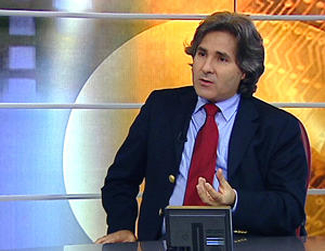 Futuro Presente
 Hitchens- political opinion maker
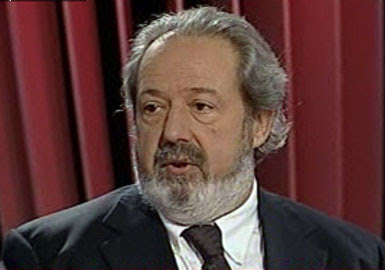 Jose Pacheco Pereira
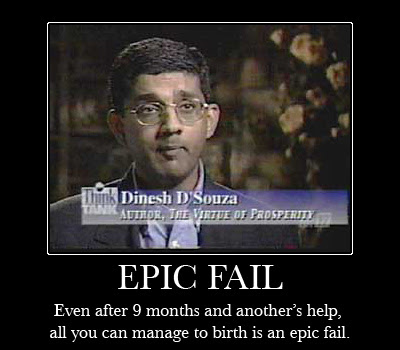 Dinesh D'Souza Christianity and Politics


 Seed Newsvine


 Oude Zak 000