Monetary Policy and Free Trade Part II
October 26, 2009
The 1973 Oil Crisis was a consequence of a series of events that illustrate the downfall of free trade whenever the governments take on expansionary monetary policies to tackle a deficit on the balance of payments, without having a strong monetary reserve to adjust parity purchase power between currencies.
_/ /_
In the light of the Smithsonian Agreements, the European Economic Community (EEC) decides to self regulate, based on the Werner report of 1970.
Nicknamed by economists as the snake in the tunnel model, basically this meant pegging all EEC currencies to one other, through the coordination of macro-economic policies of the Member States. This trading model proposed a much larger bandwith than Bretton Woods, thus allowing currencies to go up or down 4.5% to the dollar. This allowed that one currency could go up 9% relative to the other.
It was then seen as necessary to improve on the permissive nature of the snake in the tunnel. The Basle Agreements of 1972 take place on the background negotiations for the Rome Treaty with its 6 Member States.
The new model of the snake in the tunnel limited the bilateral margins between European currencies to 2.5% with a maximum turn over of 4.5% and with all moving together against the dollar. This model killed the sterling pound monetary area, but eventually also collapsed when the U.S. dollar started floating freely. in 1977 the Deutsche Mark led as the reserve currency but only with Benelux and Danemark on its tail.
__/ /_
The 1973 Oil Crisis had strong effects on the Monetary Policy.
The OAPEC proclaimed an oil embargo to sanction the U.S. support to the Israeli on the Yom Kippur war. Europe and Japan disassociated themselves from the U.S. and Kissinger had to negotiate an Israeli retreat from the Golan Heights and the Sinai Peninsula right after the end of hostilities.
Right after Bretton Woods fall, started the free floating of the U.S. dollar, and most industrialized nations increased their reserves by printing more money , which resulted in a depreciation of the dollar and because oil price was indexed in dollars, oil producers were getting less value for the petro dollars, which made them issue the statement of pegging the oil barrel prices to the gold. OPEC/OAPEC were not ready to make the institutional adjustments from the volatility of the dollar after 1967.
With the Middle East hostilities, the West was increasing their energy bill by 5% per year and selling inflation priced goods back to the oil-producers countries in the Third-World. That led to the declaration of the Shah of Iran in 1973: “You increased the price of wheat you sell us by 300%, and the same for sugar and cement…; You buy our crude oil and sell it back to us, refined as petrochemicals, at a hundred times the price you’ve paid to us…; It’s only fair that, from now on, you should pay more for oil. Let’s say ten times more.”
With the demise of Bretton Woods, the world financial system fell into a recession of inflationary prices until the 1980s, while the oil prices continued to rise up until 1986.
The 73 oil crisis marked for that same reason the very beginning of alternative energy sources research, so popular in our days.
The Oil Producers immediately started accumulating a vast wealth and pipe lined some of those monies in the form of aid to other under developed or developing countries. The International Monetary Fund also created the “Oil Facility” instrument (1974-76) destined to help most affected nations to tackle their balance of payments deficit. The IMF loans were subject to one of two pre-conditions: a petro-dollar international payment deficit or a general balance of payments deficit.
in 1975 the European Economic Community also joint efforts and approved a regulation (law) on European Community loans.
The International community first instinct was to provide support first to the industrialized countries, those who supported Liberal Capitalism in the form of free trade and financial cooperation. The other support was made available, in the form of a special line of credit, to the Developing countries, whose economies had been caught between higher prices of oil and lower prices for their own export commodities and raw materials amid shrinking Western demand for their goods.
Those Non Alignment countries more often than not, with the exception of a few remarkable cases, ended up appropriating that structural adjustment financial loans and deviating it to their ideological programs, such as rearmament and cosmetic public spending infrastructures.
That meant that the credit institutions loans, like the IMF, The Paris Club of Creditors, the London Club of Creditors, were never repaid in full, while in debt nations spiraled into consecutive loans, that were granted simply to pay for accumulated interests in the short run, in the long run they could never fully regain international confidence, simultaneously degrading their future access to credit line. A few of the final consequences over this matter were moratoriums over the payments, regime nationalizations of oil wells and even civil wars. On the other side, International Creditors even went as far as forgiving outstanding multi-billion dollars debts just to prevent another collapse of the status quo, but unwillingly legitimizing corrupted regimes in the process and preventing reform.
_/ /_
in 1979 is born the European Monetary System, in the veils of the II oil shock crisis. Back then, the dollar was floating freely and the Deutsche Mark had limited adhesion from other European currencies. The European Monetary System created a central reserve currency, called the ECU (European Currency Unit). With the ECU it was also created an European Exchange Rate Mechanism (ERM), an extension of European credit facilities and the European Monetary Cooperation Fund (precursor of the European Central Bank: that allocated ECUs to Member States in exchange for Gold and U.S. dollar deposits).
The European Exchange Rate Mechanism created a `Parity Grid` of bilateral exchange rates based on the fixed currency exchange rate margins of the ECU (a semi pegged system where fluctuations were contained within a margin of 2.25% on either side of the bilateral rates, 6% to Italy and enlarging to 15% in 1993 to sustain speculation against the french franc). The ECU fixed exchange rate was based on a weighted average of the participating currencies.
There were two ECU’s: The Official ECU (mostly an accounting unit for reference, circulating among banking institutions), and the `private` ECU (used in international financial transactions). The ECU was regulated by the European Monetary Cooperation Fund (Brussels Resolution of 1978), that would manage the `snake in the tunnel` trends, issuing currency against the deposit of 20% of gold/dollar reserves of the Central Banks of the Member States, with a trimester review of the divergence indicator.
In the 1980’s most economists began to stand for a nation’s central bank independence from the executive to ensure a smoother monetary policy (avoid its manipulation over party politics and electoral fault moves).
The debate over the European Economic Monetary Union, was again launched by the Delors Committee in 1988 (The Member States Central Banks Governors met around the President of the European Commission). And in 1989 the Delors Report set up a 3 stage plan to roll out the EMU, including the creation of The ESCB (European System of Central Banks):
-Stage 1 (1990-93)- exchange controls were abolished, thus capital movements were completely liberalised in the European Economic Community
-Stage 2 (1994-98)- The European Monetary Institute replaces European Monetary Cooperation Fund and is later baptised European Central Bank, setting up the conversion rate for the 11 participating currencies to the EURO; The Stability Pact gets approved at the European Council of Amsterdam to ensure budgetary discipline after rolling out of the euro, and a new exchange rate mechanism (ERM II) is set up to provide stability above the euro and the national currencies of countries that haven’t yet entered the eurozone.
-Stage 3- (1999)- single monetary policy is introduced under the authority of the ECB. A three-year transition period begins before the introduction of actual EURO cash.
_/ /_
In the 1990s, central banks started to adopt formal, public inflation targets with the goal of making the outcomes, if not even the process, of monetary policy more transparent. This is to say if a targeted inflation is not achieved then the central bank will typically have to submit an explanation.
The Bank of England exemplifies both these trends. It became independent of government through the Bank of England Act 1998 and adopted an inflation target of 2.5% Retail Prices Index (now 2% of Consumer Prices Index).
The underlying point is about whether monetary policy can soften up business cycles or not. Keynes principle is that the central bank can stimulate aggregate demand in the short run, because a significant number of prices in the economy are fixed in the short run and firms will produce as many goods and services as are demanded.
Nowadays most economies in the world have an inflation targeting (Conumer Price Index) type of monetary policy. These include the U.S. ( a mix model), the European Union and the single currency (EURO), Australia, Brazil, Canada and India, UK. The great exception is China.
The inflation target is achieved through periodic adjustments to the Central Bank interest rate target. The interest rate used is generally the interbank rate (ex: EURIBOR) at which banks lend to each other overnight for cash flow purposes.
To achieve inflation targets, Central Banks resort to open market operations (sales and purchases of second hand government debt or changing reserve requirements: If the central bank desires to lower interest rates, it purchases government debt, therefore increasing the amount of cash in circulation; A central bank can only operate a truly independent monetary policy when the exchange rate is floating. If the exchange rate is pegged or managed in any way, the central bank will have to purchase or sell foreign exchange).
Changes to the interest rate target are made in reaction to many market indicators in an tentative to forecast economic trends and thus keeping the market on track towards achieving the defined inflation target.
_/ /_
in 1998 the ECU exchange rates of the Eurozone countries were frozen and the value of the EURO, which then superseded the ECU at site, was therefore established. In 1999 the ERM II replaced the first ERM. A currency in ERM II is allowed to float within a range of plus or minus 15% with respect to a central rate against the euro.
The characteristics of an Economic Monetary Union are free circulation of capitals in a free market area , where member states join in common commercial policy (competition), adopting a series of convergence criteria in the macro economic sphere (budget, fiscal, monetary). Within the monetary union, there is an assurance of absolute convertibility of the currencies between each other in a fully integrated banking and financial unitarian system. Elimination of fluctuation margins and an irrevocable determination of parities.
Monetary Policy and Free Trade- Part I
October 22, 2009
After the II World War, monetary policy was quickly addressed by the world leaders who proposed to reaffirm it against the governments regulatory control. They argued that it was not to be used anymore by national governments to artificialy regulate trade deficit.
This international initiative sustained that the market economies should uphold their inherent competitive nature (supply and demand), by discouraging countries to depreciate their currency in order to obtain commercial bilateral and temporary advantages.
According to the theories of uncovered interest parity (Fisher Hypothesis) and parity purchasing power (Cassel 1918): two currencies have different purchasing power, which differential may be overcome by inflation rates. An example of one measure of PPP is the Big Mac Index made popular by the Economist magazine which looks at the prices of a Big Mac burger in McDonald’s restaurants in different countries.
This pictoresque illustration serves to show that a dollar should buy the same amount in all countries. Thus in the long run, the exchange rate between two countries should move towards the rate that equalises the prices of an identical basket of goods and services in each country.
The Big Mac PPP is the exchange rate that would mean hamburgers cost the same in America as abroad. Comparing actual exchange rates with PPPs indicates whether a currency is under- or overvalued (The Economist.com).
In other words, both imports and exports would balance one another and exempt governments from imposing strong expansionary monetary measures. There would be market regulation over policy increases in the size of the money supply, or decreases the interest rate, such as expanding currency production and restraining foreign currency exchange.
Global monetary affairs came about after the shock effect of the Great Depression in 1929, when international trade was largely restricted to currency blocs, like the sterling area and the British empire. the US State Secretary Cordell Hull (1933-1944) was a strong believer in a `Economic Security` concept based on the premise that the fundamental cause of the wars lay in economic discrimination and trade warfare.
The regulatory effect would be introduced to prevent wild fluctuations in exchange rates and sudden currency depreciation, those could disastrously stall international trade from flowing freely (like was happening in the 1930s).
The key note was convertibility of currencies. In Bretton Woods is born the system of `adjustable parities` for international payments, returning to the gold standard as it was before the war, only this time using $U.S. as the world’s new central banks reserve currency. Ongoing only until the world’s gold supply could be reallocated via the international trade ways.
The U.S. dollar became the currency with the most Parity Purchase Power and the only one backed by gold. The other countries would buy and sell dollars to keep market exchange rates within plus or minus 1% of the value.
It was a system of fixed exchange rates regulated by newly created intergovernmental financial authorities: The IMF and World Bank. The debate that ruled the discussion was between UK’s Maynard Keynes, worried about England’s post war deficit defending the deflationary measures of a world `bancor`that could issue money and mediate trade between deficit and superavit countries. While on the other side stood Dexter White for the U.S. concerned about inflationary countries.

The IMF represented a pool of national currencies and gold, subscribed by quotas issued to the member states. This institution was in charge of managing the countries deficit and overview national currency devaluations that could trigger a decline in imports. Each country’s quota would represent their relative economic power and they would pay a credit deposit of 25% in gold or dollars, that the IMF would use as loans according to size of each country’s quota. This is to say a chance for the country with a structural deficit on their balance of payments to buy their loan in foreign currency or gold, eliminating any PPP differential (maintaining stable currency exchange rates, instead of inducing a cut on the imports).
The Marshall Plan didn’t come about until the IMF reserves proved to be insufficient and only when the funds of the U.N. affiliated World Bank turned out to be over-tightly managed in securities by Wall Street. That left zero margin for European countries with deficits and no guarantees of liquidation to access loans. The GATT also was created later. Both outside the scope of this policy.
For the adjustable parities regime of Bretton Woods to work, gold had to have a fix price, each country had to decide their own parity to the dollar when declaring it to the IMF, and countries could not go over the 1% oscillation in currency exchange rate, except in a long run deficit in the balance of payments, otherwise, if temporary, they had to resort to IMF loans.
The IMF decadence however came about the end of the 50s, when its political goal, of security economics took over its fundamentally sensible and strictly macro economic inspiration. Within the context of Cold War, under pressure of keeping developing countries economies open, The World Bank relaxed its loan policies, supporting unstable regimes in South America and even contributing to what would be called the Green Revolution in the 60s.
The U.S. final attempt to rejuvenate the IMF was to create a system of triangular trade, profiting from raw material trade with under developed nations, using the surplus to sell dollars to Europe that would repay by making the U.S. the market for their products.
The U.S. internal struggle to keep gold at $35 an ounce turned sour when gold was rated higher in the open market in comparison to its fixed quote by the central banks, especially when the U.S. had to force a deficit in its balance of payments to keep the system from loosing its triangular liquidity, while at the same time a long term deficit would erode the systems confidence in the dollar as the reserve currency. European loyalty to U.S. military protection in the Cold War prevented a gold rush and kept the dollar as the reserve currency, until a reform of the system could no longer be postponed.
After the war, the U.S. produced half of the manufactured goods in the world and held half of its monetary reserves. Through the 50’s the U.S. held a balance of payments deficit in order to finance loans and troops abroad. in the 70s, the U.S. already had less than 15% of the world reserves. The U.S. commitment to fix exchange rates and compromise to convert dollars in gold upon demand was no longer sustainable. in 1967 the IMF replaces the U.S. dollar as reserve currency by the famous special drawing rights in parity with the U.S. dollar exchange rate, but non transferable except between banks and the IMF.
Each Member State would be given SDR in a 1 to 3 proportion of their quotas and these accrued interest of 1.5%.
The SDR were created to stop nations from selling dollar-pegged gold to the open market and keep the dollars instead. The European Nations owed American defense policy protection and took upon them a voluntary loss by holding on to the dollars. The SDR were created as a benchmark to put a value on the allies relationship but with no commodity/equity market to go along with that. With Vietnam war the western loyalty was put to trial against the dollar and in 1970 the U.S. gold coverage of foreign reserves were depleted down to 22%.
Nixon finally put an end to dollar-gold conversion, except on the open market. Nixon also adopted restrictive measures to American imports. First a more flexible clause was introduced to allow for a 2.25% margin of devaluation on agreed exchange rates, but eventually in 1976 currencies were back to floating and exchange rates were no longer in the center of governments monetary policy.
To rescue the system there were the Smithsonian Agreements in 1971 which devalued the dollar down to $38/ ounce and allowed for trading bands or margins in exchange rates to up or down 2.25% , continuing in exclusive with the special drawing rights. Ultimately the Agreements failed to discipline the pressure of gold against dollar.
in 1972 the gold became a floating asset and during the following ten years all the nations abandoned the currency peged exchange market. in 1973 the market opened one morning as a floating currency regime.
Berlusconi, il cavaliere
October 13, 2009

The Prime Minister of Italy is again under the spotlight, after last week, when the Supreme Court overturned a law that granted him immunity from prosecution, for as long as he held on to power. Law which had been initiated by Berlusconi himself first in 2004 and later in 2008.
Berlusconis tactics to stay in power resemble the methods of Cesare Borgia, the infamous character portrayed in Machiavelli’s book.
Cesare Borgia, son of Pope Alexander VI, was ordained in the ecclesiastical career, as was meant to be in 1494.
Borgia slipped his younger brother’s throat aiming to inherit his secular titles, by sucession in lineage. The King of Spain, Ferdinand of Aragon, however opposed the practice of releasing a cardinal from his office for political purposes. The rule of law had been broken and as a consequence the Borgias alienated their most precious ally. In the meantime Cesare bought some support from a deal cut by the Pope with the french, alienating all the italian baronial families in the process. Borgia downfall came with his fathers death and betrayal by his successor in the Vatican, Julius the II. He ended up exiled under his family protection and dies in batlle fighting his only ally, the french.
Berlusconi rise to power:
in 1994 Berlusconi’s push forward for reform of the electoral law turning the popular referendum in 1993 around which supported “The First Past the Post” system, and instead replaced that by a proportional representation with a majority prize for the winning coalition. Returning the system to the old regime.
With the end of the Cold War, also the dismemberment of the Christian Democrats came about in 1994, which had been the predominant party since 1945, giving place to the Popular Party, influenced by the Catholic Church; the neo-fascists and the left wing were re-enacted as well. The Ist Republic had been under the auspices of the U.S. since 1945, begining with the reinstatement of the mafia in local government in Sicily and ending with formal resistance against any active participation of the communists in national government. This paved the way to the political instability in Italy, by supporting a catch all parties system to isolate the communists by what the US perceived as the major ideological divide in Italy, in the context of the Cold War and the Truman Doctrine.
Historically however, the Federalists vs Centralists was the background political conflict de facto between North and South.
This interference by the U.S., intended to prevent a single party (communist) dictatorship led to a quasi-totalitarian regime: the voters had no chance to turn out a badly performing government and put in the opposition.
Bettino Craxi, socialist and last leader of the coalition had to flee the country under acusations of mafia led corruption.
This is the background for the upsurging northern separatist parties, against the corruption of the status quo (the perpetual coalition has led to immobilism)
The Northern League calls for a division of the country, in a federation like model, complaining against the misappropriation of northern taxes by the mafia in the south. The Network, another party based in the south, calls for an end to the mafia rule.
Berlusconi shows up in this context, a media tycoon, friend of Craxi, former member of Masonic lodge P2, chosen to head a coalition full of contradictions (the neo fascists centralism and anti european integration side by side with federalistst successionists).
Berlusconi sees the coalition fall in 1994 and CHANGED THE ELECTORAL LAW BACK TO BEFORE 1993, reuniting again in 2000, staying in power until 2006.
Berlusconi’s Legal Framework:
The` Gaspari Law` in 2004, comprising new media reform legislation, allowing Berlusconi to retain control over his three national tv networks , while denying favoring competition distortion. Had to go around a presidential veto.
Berlusconi was indicted in Spain for charges of tax fraud and violation of anti trust laws regarding TV network Telecinco but his mandate at the European Parliament granted him imunity from prosecution until 2005. All accused were acquited in 2008.
According to journalists Marco Travaglio and Enzo Biagi, Berlusconi entered politics to save his companies from bankruptcy: Feninvest costed Paulo Berlusconi (Sylvio’s broher) an arrest for charges of police bribery.
Reduction of the Statute of Limitations for most crimes. Under fire from the opposition, a personal friend exemption was staged (“Case Previti”) but just to be predictably overtaken by the constitutional court on grounds of “that all are equal before the law”.
The “Jowellgate”/ David Mills bribery case
Berlusconi lawyer Mills, married to british Sec of Defense, Tessa Jowel, was accused by italian prosecutors of money laundering and bribery from Berlusconi in return for perjury. Jowell resigned and got a divorce from Mills in February 2009. Mills was found guilty but is appealing to a sentence of 4 1/2 yeards in prision. Pending accusations over Berlusconi will expire in 2010 under `his` new statute of limitations.
The passing of laws by Berlusconi during ongoing trials effectively delayed the outcome (reducing punishment on all cases for false accounting: ex- law on `legitimate suspicion` where the defendant could move the trial to another court if believed the judges were bias).
Suspention of criminal trials against the five highest officers of the state during their terms (“Loddo Maccanico”). Declared insconstitutional in 2004; altered and again vetoed by the court in 2009- lifting the veil over Berlusconi and casting doubts over his future ability to ilude justice any further.
Decriminalization of false account statements (acquited both on AC Milan and Fininvest trials due to expiration under statute of limitations).
Penal code reform forbidding the prosecutors to appeal against the acquitals– declared insconstitutional.
In sum, Berlusconi brings down the judicial power in the name of perpetuation in government, digging deeper on Italy’s historic political devide, with the use of cunning and deceitful tactics.
Berlusconi most recent embarassing gaffe is that he claims to have spent millions of euros on judges , later correcting his mistake and saying he spent over 326 million dollars in lawyers and consultants dealing with investigations in which he has been involved.
Berlusconi, like Borgia alienated the people’s support, but in Italy that doesnt necessarily go against the ruler. in Fact Machiavelli had already written in his work `The Prince`, in 1513, that public morality needs to be inforced and if needed be, even by `acceptable cruel action` that requires the (ruler) to be a public figure above reproach, while privately acting ammoraly to achieve state goals.
If we consider that Italy has been called a democratic dictactorship since 1945, with the support of the US, we may very well assume that the people could not effectively be involved in the state public affairs, much like Austria. Therefore state and statesman personal affairs could be easily embroiled. Musolini himself said that Italy can be ruled, but who actually wants to do it?
in `Discourses of Livy` Machiavelli said ‘for government consists mainly in so keeping your subjects that they shall be neither able, nor disposed to injure the ruler’
Italy s a profoundly devided country, starting with the city states of The Holy Roman Empire, ruled by the Habsburgs, up to the republics under Napolean. Unified under the kindom of Sardinia, looked at by the south as an alien force, growing separatism, muffled by Musolini and release again by the allied troops.
On the other hand, the neo fascists in Berlusconi’s governmenet even demanded re opening the Traty of Osimo of 1975, which awarded the Istrian Peninsula to Yugoslavia (now Slovenia and Croatia).
Wine tasting
October 11, 2009
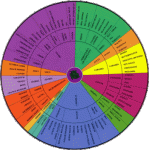
There are two basic approaches to tasting wine.
Anne Noble, emeritus Oenology professor from the University of California, is credited with the contribution of the `aroma wheel`, in 1990.
She patented a consensual terminology to define the scents identifiable in a wine. Texture and `mouth feel` were not included in the pie chart.
The wheel brakes down wine aromas into 12 categories, which in turn break down even deeper into several sub categories.
Chemical – Includes aromas like sulfur and petroleum
Pungent – Aromas like alcohol
Oxidized – Aromas like acetaldehyde
Microbiological – Aromas like yeast and lactic acid
Floral – Aromas like Pelargonium geraniums and linalool
Spicy – Aromas like licorice and anise
Fruity – Aromas like blackcurrant and apricot
Vegetative – Aromas like eucalyptus and artichoke
Nutty – Aromas like walnut and hazelnut
Caramelized – Aromas like butterscotch and molasses
Woody – Aromas often imparted by oak like vanilla and coffee
Earthy – Aromas such as mushroom and mildew
Up untill Noble, several wine glossaries would compete in equal terms to introduce the uninitiated into the lingua franca of the vino.
To me, the fun thing about wine, and that what actually differentiates wine from beer (which I drink much more casually and not to mention way more often), is the whole process of de-constructing the clues.
I cant go deeper than the first or the first two scents in my glass. I mean the ones on the surface. But Thats the beauty of wine! Its sampling is in fact available to all! Regardless of expertise, sensibility… on any social occasion, drinking wine, people are prone (even expected), at one point or the other, to comment on the wine they hold in their hands. A food dish is different, there s never a big surprise. For food the eyes almost always screen and the brain breakes the code before the actual tasting, even the best disguised design dish.
True, that in wine there are hints too: color, smell, the label, but those often work more like a trap, at least to the non-expert. Actually those relate more to the second approach to wine tasting (that i mention at the beginning)
So, in other words, wine tasting, comes down to a conversation topic with great potential. We talk about ou ability to code braking. I think the juvenile equivalent is to join a bunch of children with building blocks.
Taste is a quint essential human sense. And tanins and grapes are as old as civilization. Maybe the correlation between the significance of survival through the senses, symbolized on the grapes, as represented in major part of classic literature, the wine comes out as a synthesis between the devine and the profane.
Because wine is a celebration of the evolution of our senses through the taste buds, Its important that such experience had been made simpler to translate better, more often and by more people. Therefore my sincere recognition to Dr. Anne Noble!
A bit more complex is the second way of categorizing wine. This one outside the scope of the `aroma wheel`. Its not as intuitive as the first. While possibly also accessible to the uninitiated (I’m out for sure), this second approach to wine is less objective and surely poses a bigger challenge to terminology benchmarking.
While probably the aroma tasting is more linked to chemistry, this second part is probably more biology oriented.
Where wine (a liquid) can be labeled as `dry`, tactile reporting from the inner mouththis regards what Clinton MacSherry called
This part of the wine sampling is more technical and often left to the experts in the labs (its about what the mouth feels and not what it tastes).
An example of what is addressed in this area is Acidity, sensed mostly in the front part of the mouth, tip and sides of the tongue, and Tannins that act on the back of the cheeks, gum and front of the throat, with a dry quality like a heavily steeped tea
The balance between acidity and tannins relative to flavor components determines its degree of astringency. The ideal is the perfect equilibrium, the combination is often said to give wine its backbone.
Mladeze 13
October 8, 2009
Prague 6: Drinopol. My place! May 2005 to March 2006.
I remember snatching a Martini poster from “Hunny Bunny” at Prague 4 (Vysehrad), use it to decorate my bedroom.
In the cold winter days my clothes hanging up to dry outside would freeze to stone. I d wash them almost 40 minutes away, at a backpackers laundromat, after riding one tram and one subway, located down at Namesti Miru.
The neighbourhood supermarket sold monte velho wine, from my home land, Portugal, which I bought once to pay a visit to Chris, my old cockney colleague from Honeywell, living next to Saska Arena.
I used to jogg around the neighbourhood Hospital, which i later found out was where my beautifull colleague Dasa’s Husband worked as an orthopeadic MD, only on the day i took my brother, visiting me, in after he broke his arm playing soccer on our traditional games on thursdays.
My tv set only played 2 channells, and the first time I tuned in was on christmas day 2005, almost 7 months after my arrival.
My german flatmate cooked very thin chinese rice noodles on the stove. He provided one cd playing stereo from his place back in Dusseldorf that i tuned to play the BBC radio.
Other references on the main street included smokey hospodas selling cheap beer night in, a good restaurant selling a top 1 gulash, served in a bread carved shaped like a bowl, the famous red tram to Bila Hora with its old fashioned bell ringer.
It was an amazing experience, and I d never trade this stalinist kommunalka flat for any other place elsewhere.
My first day, I remember `stalking` my flatmate to the University to watch an ice hockey international game on plasma against Canada for the world cup. My last day I left the house stung by a rough farewell party from my friends the previous night, draging myself to catch the first taxi to the airport, with a black eye from a drinking fight, a couple of stiches, cell phone battery dead, unable to catch any transportation to the airport while my time was running out and so were my last minutes in Czech..
Relativity by M. C. Escher
October 5, 2009
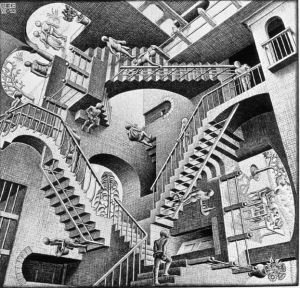
In the world of Relativity, there are actually three sources of gravity, each being orthogonal to the two others (in Wikipedia)
In the Futurama episode “I, Roommate“, Fry and Bender go apartment-hunting and visit a room that resembles the lithograph. Fry claims that he does not want to pay for a dimension he isn’t going to use; Bender then trips down one of the stairs and continues to fall (in Wikipedia)

Escher greatest expression came from his intuitive and visual concept of mathmatics, although he never had any formal training on that subject. He explored the infinity. Created images right out of his mind instead of directly from observation (surrealism). he re-invented tessellation (mosaic or tilling) by using this techinque on his art (plane figures filling the plane without gaps).
He wrote his first paper in 1936, called Regular Division of the Plane with Asymmetric Congruent Polygons, which detailed his mathematical approach to artwork creation. Escher developed a system of categorizing combinations of shape, color and symmetrical properties.
 (Wikipedia)
In Metamorphosis I, he transformed convex polygons into regular patterns in a plane to form a human motif. This effect symbolizes his change of interest from landscape and nature to regular division of a plane


Escher uses in The “Waterfall” the “bi dimensional” Penrose Triangle (“impossibility in its purest form” – Mathmatician Roger Penrose). Waterfall depicts a watercourse that flows in a zigzag along the long sides of two elongated Penrose triangles, so that it ends up two stories higher than it began
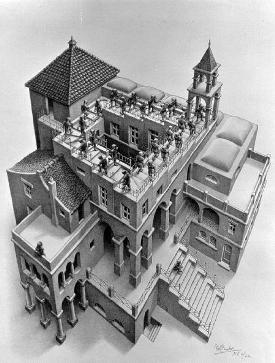
Ascending and Descending (1960).
Escher: ‘recalcitrant individuals refuse, for the time being, to take part in the exercise of treading the stairs. They have no use for it at all, but no doubt, sooner or later they will be brought to see the error of their non-conformity.’

“Convex and Concave” (1955)
One can view these features as concave by viewing the image upside-down.
Note that all additional elements and decoration on the left are consistent with a viewpoint from above, while those on the right with a viewpoint from below: hiding half the image makes it very easy to switch between convex and concave. (in Wikipedia)

“Still Life and Street” (1937)
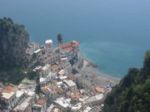
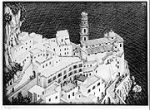 Atrani, Amalfi Coast, Italy
Bits of Bruges
October 4, 2009


“De Garre” (Triple de Garre),
The name alone makes you dream of a long distant port of the hanseatic league, covered in fog on a winter dusk.
Its one of the best bars in Brugge (not that there are many there)
Good times! Been there less then 6 times but thats because no one knows about it!!
I found a review posted by someone at boo.com
anonymous says:
“ I wouldn’t have found it if I hadn’t seen 2 men emerge from the small arch in the stone wall, but an incredible place. It will take you back in time and Yes, that house beer is strong. That and their special peach beer are the best I’ve ever tasted. They brought small chunks of cheese and it’s a… it’s a place to linger. I recommend going upstairs, but just know, you’ve got to get back down the steep, narrow stairway .
The eatery
Now, life in Bruges is definitely not night oriented. This is a UNESCO world heritage city, full of renaissance architecture and beautiful channels that earn it the nickname `the Venice of the North of Europe`.
Bars close at 12 o ‘clock and afterwards thats it! sleep-bound to the tourists and locals and dormitory resistance vigils to the College of Europe students. Add that to the fact that flemish and dutch have the strongest beers around and you will begin to understand the importance of notching before hitting the valley of the sheets.
Most of my nights out weren’t complete without having a medium or large pack of `frites` (fries). The fries were not invented by the french, but by the belgiums instead. Frites are a delicacy all over belgium, especially the flemish side of the border. As far as I know there was only one trailer that sold them at night in Bruges. This one was located in the Markt (the big square), against the walls of the city hall, in the corner with Wollestraat.
Many nights I went there, The specificity of these frites is the many sauces to chose from go with them. (paid individually). My favorite was sauce tartar even because the menu is almost always in flemish and I couldnt even spell or say most of the sauces names.
This trailer was cheap for most prices in Belgium and saved my from hunger many times.

Quick Hamburguers
Another saving grace when the hunger stroke in those many battles against studying in your room or simply coming back from a rugby practice at night several km away by train, was `quick`.
Quick is a fast food chain, sort of like McDonalds, but limited to a few countries in the Benelux area and this one in particular with a better view (right off the main square- how they convinced the authorities to open in such a priviledged zone, evades my comprehension).
They re not quick preparing your food, but it sure paid off.

Theres an Irish Pub, located right on the back of the Markt, that we used to go a lot. I fact one of the national college parties, those organized by groups of nationals in the college to celebrate their country’s traditions and values and present them to the colleagues, took place there.
If I remember well, it was kind of a sports bar, I have a vague recollection.. I keep two single individual pieces of photo memory from that place: one was on my way there with a greek coleague of mine, that got married recently, on our way to a study party with optional beer..The other one was on my way to the bathroom, looking up my shoulder and seeing a bunch of british tourists at one of those so typical football/rugby soirees they put together in Belgium and worldwide. Stella was the patron there.

Tour Del Gelato
October 2, 2009

This is a challenge launched by a bloger
We copy her url to our blog and send her a link with info on our favorite gelati parlour in the world. The goal is to determine which gelati maker is actually the best. Im not yet sure who gets to vote..
My point is i propose to offer a comlptely different `candidate`. This one made history and has the papers to prove it!
I lived in Rome, Italy and traveled all around the country for a year. I also live in the US currently. It is said these two countries, even because of their close affiliation, make and made the best gelati in thw world..
Regardless, the best gelati house ever to exist is in Portugal, not far away from where I used to live actually.
Thats right! Funny as it might sound, sometimes things are not as they seem..
I used the web site biography to copy and translate in a free way to illustrate some of the most important moments in this Gelati making Dinasty, who ended up in my home country by chance of destiny. This way I hope to enhance its name by showing enough material to faithfully display the historic moments that made this parlour what I say it is.
“CASA SANTINI“

Attilio Santini Mosena, born in Cortina d’Ampezzo, Udine, son of Arcangelo Santini and Maria Mosena. His ancestors originally from the Dolomites, north of Venice. Gelato factoring tradition in the family starts with his Great-great Grandfather, who owned a gelato parlour in Viena of Austria with brevetto issued by the imperial house, given buy the Emperor Francis Joseph. His father too, in Italy, will be awarded a brevetto from king Vittorio Emanuelle.
1917/18 Attilio leaves Italy with his father and in 1922 settles in Metz, France wher he meets one of the Romanov (Russian Imperial family) members.
In 1937returns to Italy working at the Sommariva Gellataria in Milano.
in 1938 opens a Gellataria in S. Sebastian, Spain.
in 1940 moves to Barcelona, calle Vergara, opening Gellataria Capri, which will shut down over the competition with Frigo.

| Letter of Recommendation from Gelatti Sommariva of Milano, where Attilio Santini worked in 1937 |

| Detail of one of his guest books. |
In 1944 Santini moves to Valencia, opening Café Santpol, where he will meet his wife Isabel Catalan Saez. He will also meet the Portuguese Consul João Moraes, who will challenge Santini to relocate to Portugal .

| Attilio Santini in the 1940’s, picture taken in Valência. |

| Social card of the Portuguese consul daughter, who invited Santini to relocate to Portugal. |

| Letter of Recommendation from the Milk Industry of Valencia, dated from 1946. |


Libretto of the Concerto performed by the Symphonic Orchestra of Madrid, in December 1948 at the Coliseu dos Recreios in Lisbon, under the direction of Maestro Pierino Gamba, with special dedication to Santini
August 26 1949, Santini moves to Praia do Tamariz in Estoril, with Gelataria Santini, giving away all gelatti at inauguration. Family Santini lived upstairs from the parlour, making their home available during several occasions to serve as dressing room to the Royal Family members who at the time would come to the beach.
|


Innaugural day log book; Casa Santini at Tamariz, Estoril
|

Mrs and Mr. Santini in 1950 at their parlour in Tamariz |

| Italian newspaper clip reporting about
Princess Maria Gabriela de Saboia at Gelataria do Tamariz, in company of the Santini’s daughter
|


Holiday Card in retribution to Santini’s, dated January 2nd 1951,from king Umberto II de Itália, with an illustration of the Templeof Diana in Évora on the cover.
|

| Cover of the italian Magazine Época,
with the PrincessMaria Beatriz de Saboia picture eating a gelato at Gelataria Santini
|
1955, February, 12
Caters the gelatti to the
wedding party of Princess
Maria Pia de Saboia, taking
place at Hotel Palácio

Thank you note from the Princess Maria Piade Saboia and Alexandre of Yugoslavia,with an allusive medal
|
|
|


Greeting Card from Umberto II de Itália, de 1957,with a picture of his seasonal house in Cascais Vila Itália |

| Princess Maria Gabriela de
Saboiawith Isabel Saez at the Gelataria |

| Greeting Card from
12/27/1961 sent byApostolic Nuncio in Lisboa to the Santini Family
|

| Santini’s with King of Spain
Juan Carlos who they dearly called Juanito |

| Casal Santini at the wedding
of Infanta Pilar de Borbón in Hotel Estoril Sol |

| Santini Menu July 21st
1964 served at Vila Itália, seasonal residency of the royal family of Italy |

| King Juan Carlos, Reyna Sofia
Infanta Margarida, Gelataria at Av. Valbom, Cascais (rellocated 09/08/1971) |

| Santini with the Brevetto
awarded by Umberto II de Itália 12/31/1972 as the caterer of the Royal House of Italy |

| King Umberto II de Itália
and his daugher Maria Pia with Isabel Saez, in gelataria at Av.Valbom, Cascais |

| Attilio is offered medal
of meritby thecity council of Cascais. June 7th 1994 |

| Sketch of a Biography.
Attilio dies 08/03/1995 at 88. |


| Condolences from
the Dukes of Soria |


| Santini Fuertes
current owners |
Sanduiche-iche (legendado)
October 1, 2009
My Favorite Weiss Beers
October 1, 2009
Types of beer
According to the Encyclopaedia Britannica, Weiss Beers is a a special brew (Weissbier; “white beer”) which is made from malted wheat.
1- Erdinger 
date back to 1886. Year of the wheat beer brewery in Erding. Franz Brombach, bought the brewery in 1935 and re-named it Erdinger Weissbräu on December 27, 1949.
The Most recent variety is ERDINGER Urweisse, is a rustic weissbier with a pronounced yeast flavor, traditional weissbier aroma and attractive dark golden color.
2- Schofferhofer Kristallweizen
Im going to pass a transcript from Samuel, from Sidney Australia, as I happen to simply admire his insights on beer.
Flavour is fairly sweet, but with a slightly tart edge, more of the fruit with grape tannins and kiwifruit flavours joining the mix. Slight acerbidity from carbonation and a nice weizeny finish without very much potency: a slight spice, bit of a sizzle, but no oomph behind it, lacks the mojo of a hefe. Dominating flavour is sour, with a green apple acidity to it, and it’s not well backed by a slightly watery feel that lacks depth and body.
| The Purity Law (link in Franziskaner Official Page)In 1516 Duke Wilhelm IV of Bavaria issued the Purity Law, the oldest foodstuff regulation still in effect today. Beer can only be brewed from malt, hops and water. Franziskaner weiss beers are brewed in strict adherence to the Purity Law.Take a look at the original Purity Law Decree, ready to download. |
The name of Franziskaner can be traced back to the oldest privately-owned brewery in Munich. It was founded in 1363 in the heart of town by a brewer named Seidel Vaterstetter. Being located next to a Franciscan monastery, it took on the name by which it is known today: Franziskaner.
erdinger

Schofferhofer Kristallweizen

Franziskaner


 Generacion Y
 Futuro Presente
 Hitchens- political opinion maker
 Jose Pacheco Pereira
 Dinesh D'Souza Christianity and Politics


 Seed Newsvine


 Oude Zak 000